
Buildings constructed of porous mineral building materials, such as bricks, concrete and natural stones, are subjected to weathering and atmospheric pollution. The exteriors of these buildings can experience issues such as efflorescence, freeze/thaw damage, or mold and mildew in addition to water penetration. Water is the common denominator for most if not all degradation processes that can occur. Eliminating water intrusion will prevent or significantly reduce the negative effects of previously mentioned processes. By employing Protectosil® Building Protection Products, you can ensure the protection of masonry and architectural constituents.
There are several factors that one should consider when trying to choose the most appropriate product for your situation. Some of these factors are substrate type, performance requirements of product, local VOC laws, time to retreat and environmental conditions like temperature or humidity. Our local representatives and technical services team are also available help select the right product for your project.
For normal atmospheric dirt and grime, power-washing a surface using less than 1500 psi with or without a light duty restoration cleaner is typically sufficient.
For surfaces contaminated with mold or fungus, a sodium hypochlorite (bleach) solution should be used in addition to pressure washing.
For removing efflorescence and mineral deposits, a chemical cleaner specifically designed for that application is recommended. Please follow the cleaner’s manufacturer instructions, including neutralization and cleaning of residual off the substrate. If the efflorescence is so severe none of the substrate can be seen underneath it, it is recommended that it be removed prior to treatment with Protectosil® products, as treatment may saturate the efflorescence and not penetrate into the substrate.
For removing a previously applied surface treatment, please contact the manufacturer of that product for the appropriate method of removal.
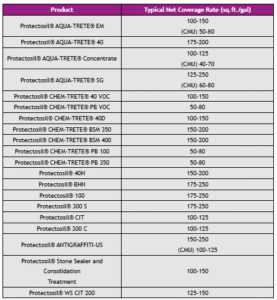
Please find a chart below containing general coverage rates for all Protectosil® products. Keep in mind these are suggested coverage rates, and different substrates will accept product slightly differently. Speaking to your local Protectosil® representative or Protectosil® technical services will help finalize any questions about coverage rate and application. You MUST reach out to the local Protectosil® representative to confirm this coverage rate before application to request a warranty on any given project.
Protectosil® products are reactive with moisture in substrates to begin bonding, and as such should be applied when surfaces are going to be as dry as possible. They should be applied at least 24 hours before rain is forecasted to ensure no surface reactions and that most of the interstitial substrate reactions aren’t disrupted. After it rains you must wait 48 hours. At this time Protectosil® products can be applied.
For surfaces contaminated with mold or fungus, a sodium hypochlorite (bleach) solution should be used in addition to pressure washing.
For removing efflorescence and mineral deposits, a chemical cleaner specifically designed for that application is recommended. Please follow the cleaner’s manufacturer instructions, including neutralization and cleaning of residual off the substrate. If the efflorescence is so severe none of the substrate can be seen underneath it, it is recommended that it be removed prior to treatment with Protectosil® products, as treatment may saturate the efflorescence and not penetrate into the substrate.
For removing a previously applied surface treatment, please contact the manufacturer of that product for the appropriate method of removal.
Protectosil® products can be applied on concrete surfaces that have reached 80% of compressive design strength and 8% or less moisture content. Please consult your Protectosil® representative or the technical services team for specific or special circumstances or mixes.
For surfaces contaminated with mold or fungus, a sodium hypochlorite (bleach) solution should be used in addition to pressure washing.
For removing efflorescence and mineral deposits, a chemical cleaner specifically designed for that application is recommended. Please follow the cleaner’s manufacturer instructions, including neutralization and cleaning of residual off the substrate. If the efflorescence is so severe none of the substrate can be seen underneath it, it is recommended that it be removed prior to treatment with Protectosil® products, as treatment may saturate the efflorescence and not penetrate into the substrate.
For removing a previously applied surface treatment, please contact the manufacturer of that product for the appropriate method of removal.
The only true way to ensure compatibility of Protectosil® products with any other products is a test patch. However, most Protectosil® products (with the exception of CHEM-TRETE® 40D, BHN Plus, AQUA-TRETE® SG, and ANTIGRAFFITI®-US due to additives preventing paint/stain penetration) can typically be painted over with solvent-borne or water-borne acrylic, epoxy, or oil-based paints and stains. The challenge is in the surfactants and other additives in coatings. Any surface already treated with any films will resist Protectosil® penetrating water repellent sealers, and therefore Protectosil® products MUST be applied first.
For more specific questions or more complex systems, please reach out to Protectosil® technical services for compatibility information.
For surfaces contaminated with mold or fungus, a sodium hypochlorite (bleach) solution should be used in addition to pressure washing.
For removing efflorescence and mineral deposits, a chemical cleaner specifically designed for that application is recommended. Please follow the cleaner’s manufacturer instructions, including neutralization and cleaning of residual off the substrate. If the efflorescence is so severe none of the substrate can be seen underneath it, it is recommended that it be removed prior to treatment with Protectosil® products, as treatment may saturate the efflorescence and not penetrate into the substrate.
For removing a previously applied surface treatment, please contact the manufacturer of that product for the appropriate method of removal.
Generally, structures treated with Protectosil® penetrating water repellants require less maintenance compared to unprotected structures. All Protectosil® products require a minimum 7 day cure prior to any attempted cleaning.
When the need to clean a treated structure arises, the following methods and/or cleaners will not affect the performance of the Protectosil® application, nor will re-application be required as a result of cleaning. For normal atmospheric dirt and grime, power-washing at 1500 psi is usually sufficient. It is acceptable to use a light duty restoration detergent or Trisodium Phosphate (TSP) in conjunction with power-washing. For surfaces contaminated with mold or fungus, a sodium hypochlorite solution should be used in addition to pressure washing. Since Evonik silane water repellents chemically bond with brick, CMU, concrete, and mortar, most chemical cleaners will not hinder their effectiveness. When acidic cleaners are utilized to clean a structure, be sure to rinse the surface with large amounts of water to completely remove the acid from the surfac
Several options for this exist. One is submitting a sample core from the site to the technical services department. This department of Protectosil® performs depth of penetration, water absorption, and chlorides testing. Before submitting any samples, first you must reach out to your local Protectosil® representative. Additionally, you must fill out the Sample Submittal Form. Please find this linked here.
The second method for testing for successful application of water repellent is with a RILEM tube test. RILEM, headquartered in Paris, is the International Union of Testing and Research Laboratories for Materials and Structures. As with the American Society for Testing for Materials (ASTM), technical Committees are formed within RILEM to develop standard methods for measuring properties and evaluating the performance and durability of many different building materials.
RILEM Test Method II.4 provides a simple means for measuring the rate at which water moves through porous material, such as masonry. The test can be performed at the site or in the laboratory and can be used to measure vertical or horizontal water transport.
The equipment necessary for measuring water absorption under low pressure is simple. A pipe-like apparatus has been designed for use on horizontal and vertical surfaces. Its flat, circular brim (at the bottom end of the pipe) is affixed to the masonry surface by interposing a piece of putty.
For more specific questions or more complex systems, please reach out to Protectosil® technical services for compatibility information.
For surfaces contaminated with mold or fungus, a sodium hypochlorite (bleach) solution should be used in addition to pressure washing.
For removing efflorescence and mineral deposits, a chemical cleaner specifically designed for that application is recommended. Please follow the cleaner’s manufacturer instructions, including neutralization and cleaning of residual off the substrate. If the efflorescence is so severe none of the substrate can be seen underneath it, it is recommended that it be removed prior to treatment with Protectosil® products, as treatment may saturate the efflorescence and not penetrate into the substrate.
For removing a previously applied surface treatment, please contact the manufacturer of that product for the appropriate method of removal.
Each application of Protectosil® products will start at different protection levels to maintain optimum performance, but our sales representatives, technical service departments, and local agents are available to assist in making these determinations accurately.
The life cycle of Protectosil® products is based on the assumption that retreatment should occur before a significant drop-off in performance. This is assumed to be 25% from the starting values. Of course each system starts at different protection levels and the re-treatment times are to maintain optimum performance. The common water repellent tests (RILEM tube, water absorption, depth of penetration) can be used to verify continued water repellency if concerns arise.
Yes, Evonik offers material only or labor and material warranties for most products at cost. Other specialized warranties exist for corrosion inhibitors, monitoring, etc. For ALL warranty requests, contact your Protectosil® regional manager before any application of Protectosil® products. See subsection Warranties for more information.
Protectosil® can be purchased directly and through local distributors. Reach out to your local Protectosil® sales manager or see subsection Distributors for more details.